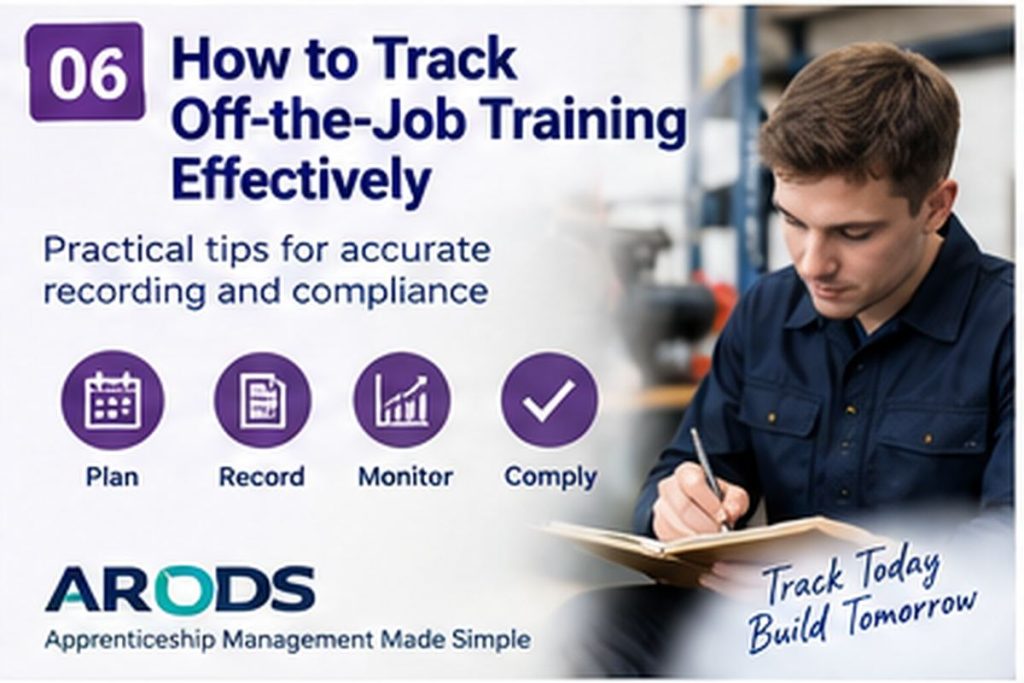
Off-the-job training tracking is one of the most important functions of apprenticeship management.
Providers need a reliable way for learners to record qualifying activity and for tutors and managers to understand whether progress is on track.
Many organisations begin with spreadsheets or paper records.
This can work with a small number of learners.
As the number of apprentices increases, however, manually checking OTJ activity becomes increasingly difficult.
Managers may need to:
An automated apprenticeship management system can reduce this workload.
A useful OTJ tracking system should provide:
ARODS provides online OTJ recording and an early-warning system designed to notify staff when OTJ targets are not being met.
This gives providers an opportunity to intervene earlier.
The real value of OTJ software is not simply recording hours.
It is identifying problems.
For example:
Learner A: On target.
Learner B: Slightly behind.
Learner C: Significantly behind.
The manager should be able to see those differences without manually calculating every learner.
OTJ information can also support progress reviews.
If a learner is behind target, that should become a discussion point rather than remaining hidden inside a spreadsheet.
OTJ information becomes more useful when considered alongside broader learner progress. A progress review can provide an opportunity to discuss recorded activity, planned training, outstanding work, and any barriers affecting participation. Connecting OTJ tracking with reviews and management information turns the record into a practical management tool rather than a standalone spreadsheet.
An effective process focuses attention on exceptions. If a learner has recorded significantly less activity than expected, the next step may be to understand why. The cause could be missing records, a change in circumstances, scheduling issues or a genuine lack of activity. Early investigation gives the provider more opportunity to resolve the underlying problem before it becomes harder to recover.
Simply adding up recorded OTJ hours does not necessarily tell a manager whether a learner is progressing as expected. The system should provide context, including the learner’s program period and expected activity. This allows staff to distinguish between a learner who is on track and one whose recorded activity is falling behind. Providers should always ensure that the targets and calculations they use reflect current official requirements and their approved delivery arrangements.
Effective off-the-job training tracking begins with a clear understanding of what is expected from each learner. Providers need to know the relevant program requirements and establish how the activity will be recorded. Learners should understand what information they need to provide and when records should be submitted. Clear expectations reduce incomplete entries and make later monitoring more reliable.
When OTJ records are current and easy to understand, they can also improve conversations between learners and their tutors or coaches. Instead of discussing progress in general terms, staff can review the recorded activity and agree on practical next steps.
Effective OTJ management requires more than collecting hours.
It requires visibility, timely intervention, and consistent records.
An apprenticeship management system such as ARODS can bring OTJ recording and monitoring into the wider apprenticeship delivery process
©2026 CyberNexus Ltd. All Rights Reserved.
Subscribe and get exclusive content and special offers.
