
Forecast late completions with a high level of accuracy.
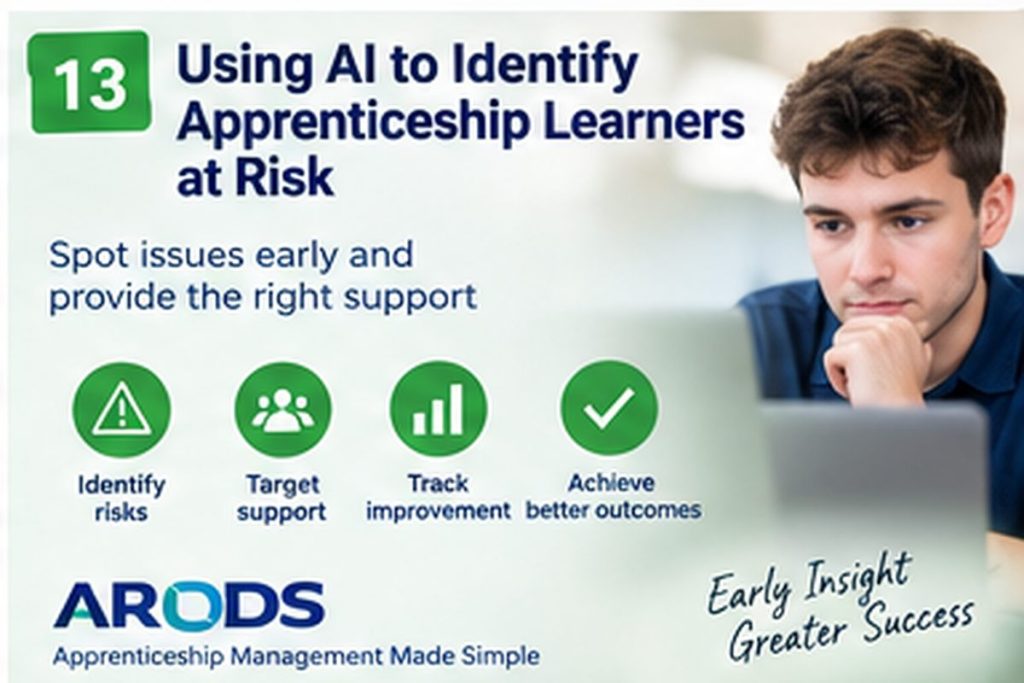
One of the most promising applications of AI in apprenticeship management is identifying learners who may be at risk of falling behind.
The concept is simple.
Instead of waiting for a learner to fail to meet a milestone, software can analyse available information and highlight potential concerns earlier.
A learner may become at risk because of several factors:
No single factor necessarily means a learner will fail.
The value comes from looking at patterns.
With a small learner population, a tutor may recognise problems quickly.
With hundreds of learners, management needs a more systematic approach.
ARODS uses its integrated AI assistant, Ainsley, as part of its approach to monitoring delivery and identifying potential issues.
The ARODS website also promotes predictive completion-risk functionality.
Such predictions should be treated as management signals rather than guaranteed outcomes.
This is where human intervention matters.
A risk alert should lead to:
AI identifies the signal.
People decide what to do about it.
The earlier a genuine problem is identified, the more options the provider has.
A missed assignment may be easy to resolve.
The same problem repeated for several months may become much harder to recover.
Risk monitoring can also reveal broader patterns. If a particular cohort consistently develops issues at the same stage, the provider may need to review the process rather than treating every learner separately. Similarly, repeated issues within a caseload may identify a training or support need. Used carefully, AI-assisted risk monitoring can therefore support both early intervention and continuous improvement.
Not every risk requires the same response. A minor delay may need a reminder, while a repeated pattern could require a conversation involving the learner, tutor and employer. Management systems can help organise these cases by priority, but the response should be based on the circumstances of the individual learner. Recording the intervention also provides a useful history for subsequent reviews.
A useful risk alert should give managers enough information to understand why a learner has been highlighted. Staff need to be able to investigate the underlying records rather than receiving a score with no explanation. Clear links to relevant activity, reviews, evidence or OTJ information can make an alert more actionable and reduce the time required to establish the context.
Effective apprenticeship risk monitoring should avoid relying on a single metric. A missed assignment may be insignificant on its own, while a pattern involving missed deadlines, low activity and overdue reviews may deserve attention. Combining different signals can provide a more useful picture of where intervention may be worthwhile. The underlying data should still be checked by staff before decisions are made.
AI-assisted learner monitoring has the potential to move apprenticeship management from reactive reporting towards earlier intervention.
The most useful systems will combine automated identification with clear information that allows tutors and managers to make informed decisions.
Effective apprenticeship progress reviews provide a structured way to review progress and agree actions.
Apprenticeship management dashboards can turn delivery data into clearer management information.
©2026 CyberNexus Ltd. All Rights Reserved.
Subscribe and get exclusive content and special offers.
