An Easy Tracker
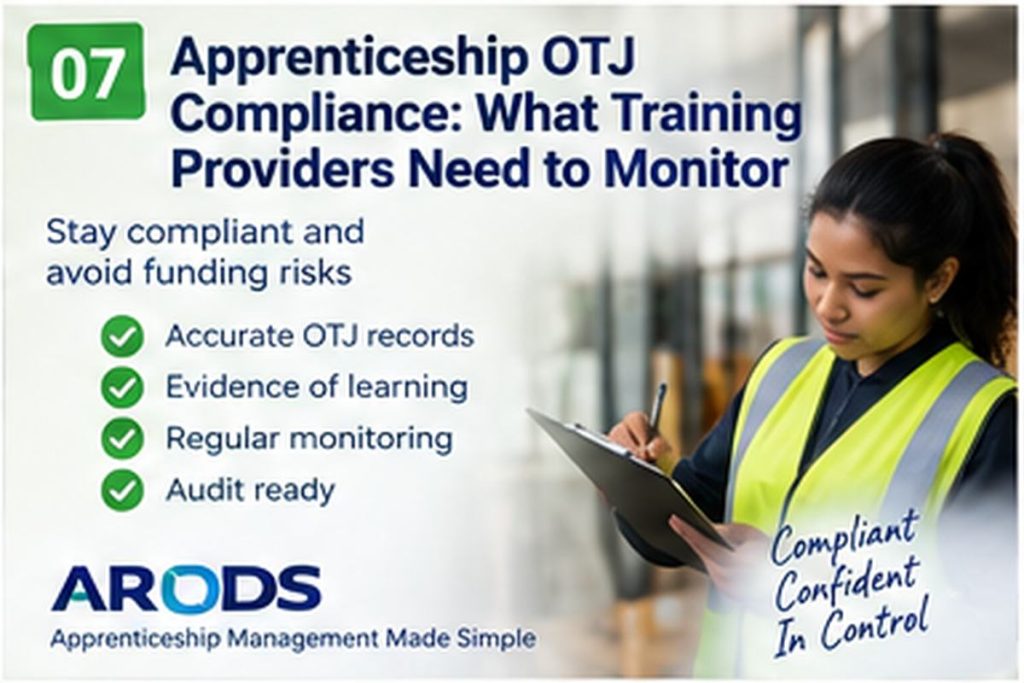
Off-the-job training is an important part of apprenticeship delivery, and providers need processes that allow them to record and monitor relevant activity.
The exact requirements should always be checked against current official apprenticeship funding and programme guidance.
Technology can support the process, but it does not remove the provider’s responsibility for understanding the rules.
At a practical level, providers should have visibility of:
A spreadsheet may show recorded hours, but it may not provide the workflow needed to manage hundreds of learners.
Someone still has to:
That is where automation can help.
ARODS provides online OTJ recording and early-warning functionality designed to identify when targets are not being met.
The system therefore approaches OTJ as a continuous management process rather than simply a historical record.
A useful management dashboard might show:
The objective is to make exceptions visible.
No software can guarantee compliance simply because a record exists.
The provider still needs:
Software should support those processes.
Managers should also consider OTJ performance across cohorts, programmes and delivery teams. A recurring pattern may indicate a process problem rather than a series of unrelated learner issues. Reviewing trends can therefore support quality improvement, staff support and more effective planning. A dashboard that combines learner-level detail with higher-level management information can make this analysis considerably easier.
When an issue is identified, there should be a clear next step. Staff may need to speak with the learner, check the training plan, discuss the position with a tutor or coach, or involve the employer where appropriate. Recording the action taken creates a clearer management trail and helps prevent the same issue from being overlooked at the next review.
Compliance monitoring is not only about finding learners with a low total. Missing entries, sudden changes in activity and unusual patterns may also deserve attention. A digital system can make these exceptions easier to identify than a manual spreadsheet, particularly when there are hundreds of learners. The purpose of an alert is to prompt investigation; it should not be treated as proof that a learner or provider has failed to comply.
A reliable OTJ process should make it possible to understand what activity has been recorded, when it took place and how it relates to the learner’s programme. Providers should ensure that records are sufficiently clear to support internal review and any later quality or compliance checks. The exact evidence and recording requirements should always be checked against the current official guidance that applies to the apprenticeship.
OTJ monitoring is most effective when it is integrated into normal apprenticeship delivery.
ARODS provides a way to record OTJ activity and surface potential issues through its management and warning functionality.
©2026 CyberNexus Ltd. All Rights Reserved.
Subscribe and get exclusive content and special offers.
